

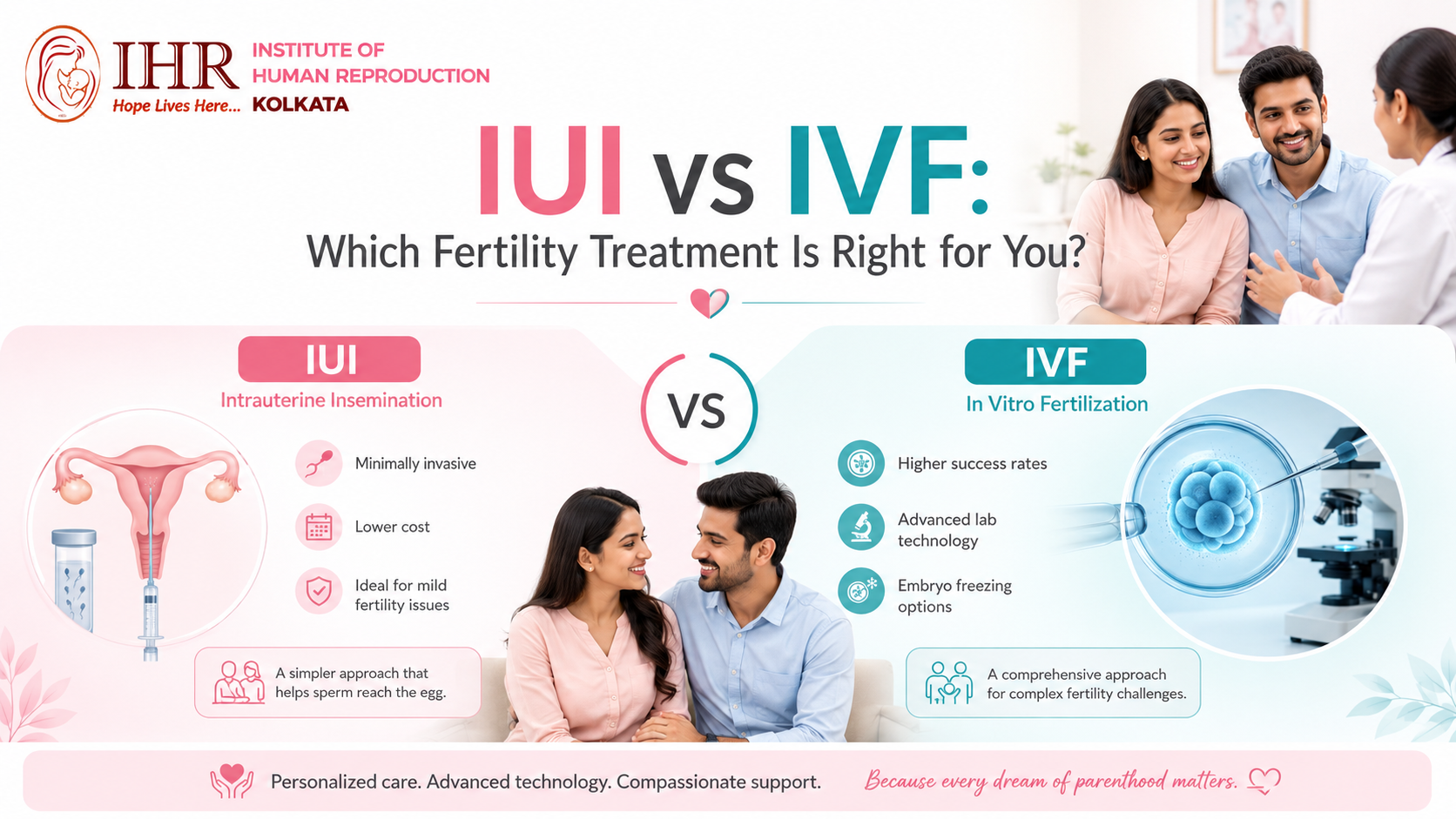
For many couples, the journey to pregnancy is not always simple. When pregnancy does not happen naturally, fertility treatments like IUI and IVF can help. But many couples feel confused about IUI vs IVF and wonder which fertility treatment is right for them.
Two of the most commonly discussed fertility treatments are IUI and IVF. Many couples feel confused about which option is better for them. Some wonder, “Should we try IUI first?” while others ask, “Is IVF the right choice for faster results?”
Both IUI treatment and IVF treatment can help couples achieve pregnancy, but they are used in different situations. The right choice depends on age, sperm quality, fallopian tube health, ovulation, previous treatment history, and fertility reports.
At IHR IVF Kolkata, couples receive personalized fertility guidance to understand the difference between IUI and IVF and choose the treatment that suits their condition.
What Is IUI?
IUI stands for Intrauterine Insemination. It is a simple fertility treatment where specially prepared sperm is placed directly inside the woman’s uterus around the time of ovulation.
In a natural pregnancy, sperm travels from the vagina through the cervix and uterus to reach the egg. In IUI, the sperm is placed closer to the egg, which increases the chance of fertilisation.
IUI may be done in a natural cycle or with fertility medicines. These medicines may help the ovaries produce one or more eggs. The doctor tracks ovulation through ultrasound and then performs the IUI procedure at the right time.
The procedure is usually quick and does not require surgery. Most women can go home soon after the procedure.
What Is IVF?
IVF stands for In Vitro Fertilisation. In IVF, eggs are collected from the woman’s ovaries and fertilised with sperm in a laboratory. Once embryos are formed, the best embryo is transferred into the uterus.
IVF is a more advanced fertility treatment compared to IUI. It gives doctors more control over the process because fertilisation happens outside the body in a lab.
IVF usually involves ovarian stimulation, egg retrieval, sperm preparation, fertilisation, embryo development, and embryo transfer. In some cases, advanced techniques like ICSI may also be used, especially when sperm quality is low.
IVF may be recommended when simpler treatments are not suitable or have already failed.
Main Difference Between IUI and IVF
The biggest difference between IUI and IVF is where fertilisation happens.
In IUI, fertilisation happens naturally inside the woman’s body. The doctor only helps by placing sperm closer to the egg.
In IVF, fertilisation happens outside the body in a laboratory. The embryo is then placed into the uterus.
This makes IVF more advanced than IUI. It also allows doctors to check egg quality, sperm quality, fertilisation, and embryo development more closely.
When Is IUI Recommended?
IUI may be suitable for couples who have mild fertility issues. It is often considered when the woman’s fallopian tubes are open and ovulation is happening naturally or can be supported with medicines.
IUI may be suggested in cases such as mild male factor infertility, unexplained infertility, ovulation problems, cervical mucus issues, or when donor sperm is being used.
It may also be considered for younger women who have been trying to conceive for some time but do not have major fertility problems.
However, IUI may not work well in all cases. If the fallopian tubes are blocked, sperm count is very low, age is advanced, or there are severe fertility issues, IVF may be a better option.
When Is IVF Recommended?
IVF is usually recommended when there are more serious fertility concerns or when other treatments have not worked.
IVF may be advised in cases of blocked fallopian tubes, severe male infertility, very low sperm count, poor sperm movement, low AMH, advanced maternal age, endometriosis, repeated IUI failure, unexplained infertility, or previous miscarriage concerns.
IVF may also be helpful when couples need advanced procedures like ICSI, donor egg IVF, embryo freezing, genetic testing, or fertility preservation.
For couples who have been trying for many years, IVF may offer a more structured treatment plan.
IUI vs IVF: Which Has Better Success Chances?
IVF generally has a higher chance of success than IUI because the egg and sperm are handled in a controlled laboratory environment. Doctors can monitor fertilisation and embryo development before transfer.
IUI is simpler, but it depends more on natural fertilisation inside the body. Because of this, its success depends strongly on factors like age, ovulation, sperm quality, and tube health.
For younger couples with mild fertility problems, IUI may be a good first step. But for couples with more complex fertility issues, IVF may provide better chances.
Still, no treatment can guarantee pregnancy. Fertility treatment success depends on many personal factors. This is why a proper fertility evaluation is very important before choosing between IUI and IVF.
IUI vs IVF: Which Is More Affordable?
IUI is usually more affordable than IVF because it is a simpler procedure. It does not involve egg retrieval, embryo culture, or laboratory fertilisation.
IVF costs more because it includes multiple steps, medicines, lab procedures, monitoring, egg collection, fertilisation, embryo transfer, and sometimes advanced techniques.
However, cost should not be the only factor when choosing treatment. Sometimes, couples try multiple IUI cycles without success and later move to IVF. In such cases, the total emotional and financial burden can increase.
A fertility specialist can help you understand whether it is better to start with IUI or move directly to IVF based on your reports.
Is IUI Painful?
IUI is usually not painful. Some women may feel mild cramping or discomfort during the procedure, similar to a routine gynaecological check-up. The procedure is short and usually does not require rest for many days.
Most women can continue normal daily activities after IUI, unless the doctor advises otherwise.
Is IVF Painful?
IVF is more detailed than IUI, but it is usually manageable with proper medical care. Some women may feel discomfort due to hormone injections, bloating, or egg retrieval. Egg retrieval is done under medical supervision, so pain is usually controlled.
The emotional journey of IVF can sometimes feel more challenging than the physical process. This is why counselling, clear communication, and supportive care are very important during IVF treatment.
At IHR IVF, the team focuses not only on treatment but also on guiding couples emotionally throughout their fertility journey.
Should You Try IUI Before IVF?
This depends on your fertility condition.
Trying IUI before IVF may be suitable if you are young, your fallopian tubes are open, sperm quality is acceptable, ovulation is normal or manageable, and there are no major fertility issues.
But IVF may be recommended sooner if the woman is above 35, the fallopian tubes are blocked, sperm quality is poor, AMH is low, there is severe endometriosis, or previous IUI cycles have failed.
Age is an important factor in fertility. Waiting too long with repeated low-chance treatments may reduce the chances of success for some couples. That is why it is important to take medical advice early.
How Many IUI Cycles Should You Try?
Many doctors may suggest a few cycles of IUI before moving to IVF, depending on the couple’s condition. But the number of attempts should not be the same for everyone.
If IUI fails repeatedly, it is important to review the treatment plan. The doctor may suggest further tests or recommend IVF.
Couples should avoid losing valuable time, especially if age or ovarian reserve is a concern.
Which Treatment Is Right for You?
The right treatment depends on your diagnosis. There is no single answer for every couple.
IUI may be right for you if your fertility issue is mild, your tubes are open, your age is favourable, and sperm quality is reasonably good.
IVF may be right for you if you have blocked tubes, severe male infertility, low ovarian reserve, advanced age, endometriosis, repeated IUI failure, or unexplained infertility for a long time.
The best way to decide is to meet a fertility specialist, complete the required tests, and understand your chances with each treatment option.
Why Choose IHR IVF for Fertility Treatment in Kolkata?
Choosing the right fertility clinic is an important step in your parenthood journey. At IHR IVF Kolkata, couples receive complete support for different fertility concerns, including IUI treatment, IVF treatment, ICSI, male infertility treatment, egg donation, fertility preservation, and advanced reproductive care.
If you are confused about IUI vs IVF, the fertility specialists at IHR IVF can review your reports and explain which treatment may be more suitable for you. The team focuses on clear guidance, emotional support, and personalised treatment planning.
For couples looking for a trusted IVF centre in Kolkata or expert fertility treatment in Kolkata, IHR IVF offers care designed around each couple’s medical needs and pregnancy goals.
Conclusion
IUI and IVF are both helpful fertility treatments, but they are used for different situations. IUI is simpler, less invasive, and may be suitable for mild fertility issues. IVF is more advanced and may be better for couples with complex fertility problems or repeated treatment failure.
The right choice should not be based on fear, assumptions, or online information alone. It should be based on your age, medical history, fertility reports, and expert advice.
If you are confused about whether IUI or IVF is right for you, book a consultation at IHR IVF. A fertility specialist can review your case and help you take the next step with confidence.
FAQs
 Medically reviewed by
Dr. Surya Agarwal
MBBS, MD (Obstetrics & Gynaecology) · Fellowship in Reproductive Medicine
Last reviewed: June 2026
View profile
Medically reviewed by
Dr. Surya Agarwal
MBBS, MD (Obstetrics & Gynaecology) · Fellowship in Reproductive Medicine
Last reviewed: June 2026
View profile
.png) (+91) 9864103333
(+91) 9864103333 (+91) 9435502020


