

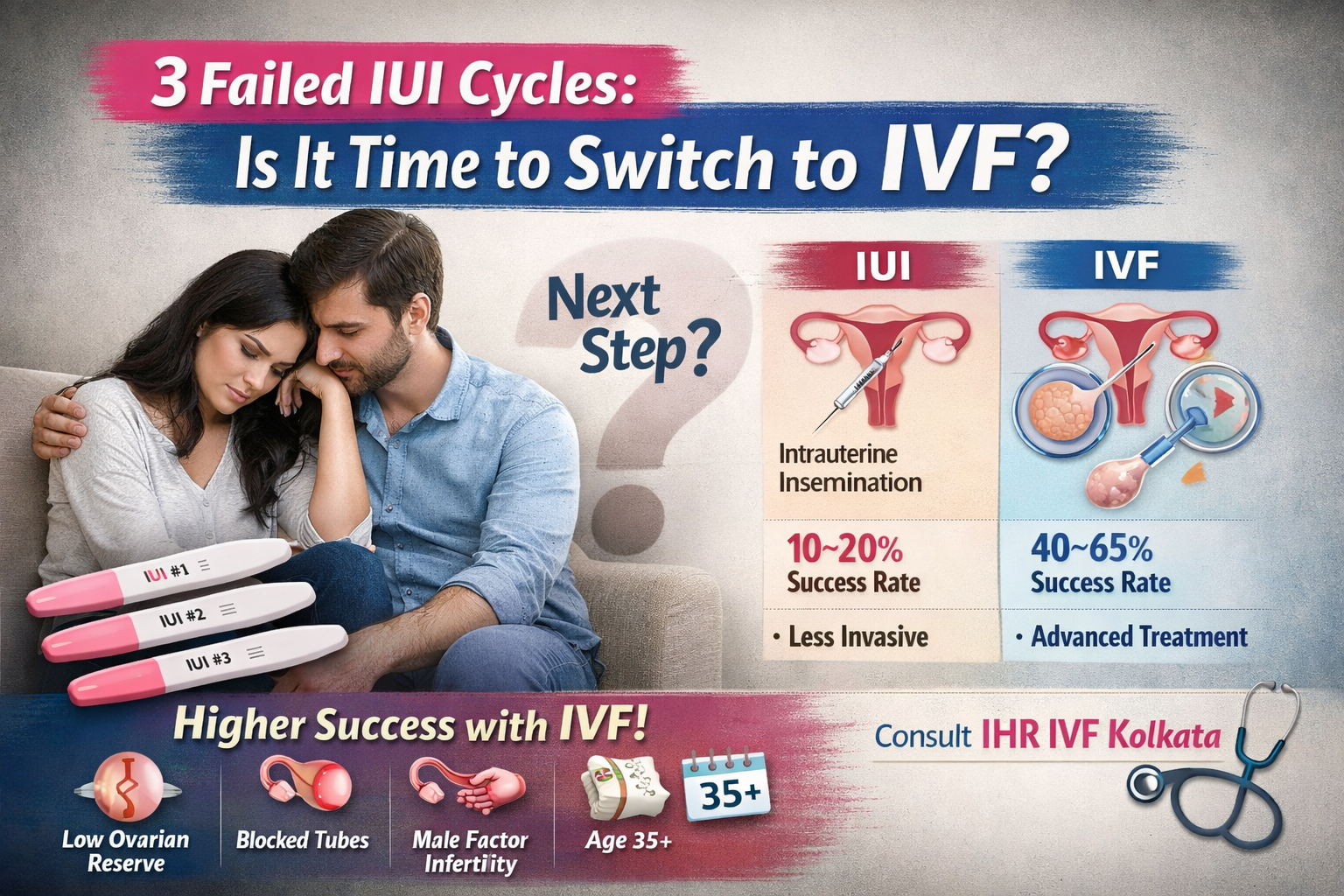
Going through IUI (Intrauterine Insemination) cycles without a positive result is one of the most emotionally exhausting experiences a couple can face. After the first failed attempt, there is hope. After the second, there is still determination. But by the third failed IUI cycle, many couples find themselves asking a very important question:
“Is it time to move on to IVF?”
This is not just an emotional decision – it is a clinical one. And understanding the medical reasoning behind it can make the journey forward much clearer.
What Is IUI and How Does It Work?
IUI (Intrauterine Insemination) is a fertility treatment where carefully prepared sperm is placed directly into the uterus around the time of ovulation. It is a minimally invasive procedure that improves the chances of sperm reaching the egg naturally.
IUI is usually the first-line fertility treatment recommended for:
- Mild male factor infertility (low sperm count or motility)
- Unexplained infertility
- Cervical mucus issues
- Couples who require donor sperm
It is a simple, affordable, and relatively low-risk procedure. However, the success rate per cycle is modest – typically ranging between 10% to 20% per attempt, depending on the woman’s age and the underlying cause of infertility.
Why Does IUI Fail? Common Reasons Behind Failed IUI Cycles
Understanding why IUI fails is the first step in deciding what comes next. Here are the most medically recognised causes of IUI failure:
1. Poor Egg Quality As women age, particularly after 35, egg quality declines. If the eggs are not of sufficient quality to be fertilised or develop into a healthy embryo, IUI may not succeed regardless of how many cycles are attempted.
2. Fallopian Tube Blockage IUI depends on the fallopian tubes being open so the sperm can travel to meet the egg. Even a partial blockage can significantly reduce IUI success. A Hysterosalpingography (HSG) test can detect this.
3. Low Ovarian Reserve (Low AMH) A low Anti-Mullerian Hormone (AMH) level indicates fewer eggs in the ovaries. When ovarian reserve is low, the response to ovulation-stimulating medications is poor, making IUI less effective.
4. Severe Male Factor Infertility If the sperm count, motility, or morphology is significantly below normal, IUI may not deliver enough healthy sperm close enough to the egg for fertilisation to occur.
5. Endometriosis Endometriosis creates an inflammatory environment in the pelvis that can interfere with fertilisation and implantation, reducing IUI success rates considerably.
6. Uterine Abnormalities Conditions such as fibroids, polyps, or an irregular uterine cavity can prevent a fertilised egg from implanting properly after IUI.
7. Timing Issues If ovulation is not tracked precisely, the insemination may not coincide with the ideal fertility window, reducing the procedure’s effectiveness.
After 3 Failed IUI Cycles – What Do Medical Guidelines Say?
Most fertility specialists and international reproductive medicine guidelines recommend reconsidering the treatment approach after 3 to 6 failed IUI cycles. Here is why:
- The cumulative success rate of IUI does not increase significantly beyond 3–4 cycles.
- Continuing IUI after repeated failures may delay more effective treatment, which can be particularly important for women over 35 where time is a critical factor.
- A systematic clinical review after 3 failed cycles can reveal underlying issues that were not apparent earlier.
This does not mean IVF is mandatory for every couple after 3 failed IUIs. But it does mean that a thorough fertility assessment with a specialist is essential before deciding the next step.
IUI vs IVF: Understanding the Key Difference
| Feature | IUI | IVF |
| Fertilisation Location | Inside the body (in vivo) | Outside the body (in vitro) |
| Procedure Complexity | Minimally invasive | More involved (egg retrieval + embryo transfer) |
| Success Rate per Cycle | 10–20% | 40–65% (depending on age and clinic) |
| Suitable For | Mild fertility issues | Moderate to severe infertility |
| Monitoring Required | Moderate | Intensive |
IVF (In-Vitro Fertilisation) bypasses many of the obstacles that cause IUI to fail. In IVF, eggs are retrieved directly from the ovaries, fertilised with sperm in a controlled laboratory environment, and the resulting embryo is transferred directly into the uterus. This process eliminates the role of the fallopian tubes and significantly improves the chances of successful fertilisation and implantation.
When Should You Switch from IUI to IVF?
Your fertility specialist may recommend moving to IVF if any of the following conditions apply:
- 3 or more failed IUI cycles with no clear explanation
- Age 35 or above – time is a medically relevant factor in fertility
- Diagnosed low ovarian reserve (low AMH or low antral follicle count)
- Moderate to severe endometriosis
- Both fallopian tubes are blocked or damaged
- Significant male factor infertility – IVF with ICSI (Intracytoplasmic Sperm Injection) can fertilise an egg even with very few healthy sperm
- Previous diagnosis of genetic conditions – IVF allows for Preimplantation Genetic Testing (PGT) before embryo transfer
What Makes IVF More Effective After Failed IUI?
In IVF, the entire fertilisation process is monitored and controlled in a state-of-the-art embryology laboratory. Here is what makes it clinically superior in cases of repeated IUI failure:
Better Fertilisation Control: The egg and sperm are brought together in a laboratory setting, dramatically increasing the chances of fertilisation compared to IUI, where sperm must travel to the egg unassisted.
Embryo Selection: Advanced techniques such as embryo grading and Preimplantation Genetic Testing (PGT) allow embryologists to select the healthiest embryos for transfer, reducing the risk of implantation failure.
ICSI Technology: When male factor infertility is a concern, ICSI (Intracytoplasmic Sperm Injection) – where a single sperm is injected directly into an egg – can significantly improve fertilisation rates.
ERA (Endometrial Receptivity Analysis): This advanced test identifies the precise window of implantation for each individual woman, improving the timing of embryo transfer and increasing success rates.
IVF Success Rates: What Can You Realistically Expect?
At a leading IVF centre, the success rates for IVF are significantly higher than IUI. At IHR IVF, Kolkata, one of India’s most experienced fertility centres with over 40 years of expertise and more than 30,000 successful IVF treatments, the success rates are:
- First IVF attempt: 50% to 65%
- Two IVF attempts: approximately 85%
- Three IVF attempts: approximately 95%
These figures reflect the impact of advanced technology, experienced embryologists, and personalized treatment protocols – all of which are critical to improving outcomes after failed IUI cycles.
Emotional Impact of Repeated IUI Failure – You Are Not Alone
Three failed IUI cycles can take a significant toll on mental and emotional well-being. Feelings of grief, anxiety, frustration, and helplessness are completely normal and valid. It is important to:
- Allow yourself to process these emotions without judgment
- Seek the support of a qualified fertility counsellor (IHR IVF has dedicated fertility counselling as part of its care approach)
- Make decisions based on both clinical guidance and your own readiness
- Understand that IUI failure is not a reflection of your health or worth as a person — it is a medical situation with medical solutions
Questions to Ask Your Fertility Specialist Before Moving to IVF
Before transitioning from IUI to IVF, it is advisable to have a detailed consultation where you can ask:
- What specific investigations will be done to understand why IUI failed?
- Is my IVF protocol going to be customized based on my test results?
- What additional tests (ERA, PGT, AMH, sperm DNA fragmentation) are recommended?
- What are my realistic chances of IVF success based on my age and diagnosis?
- What are the cost and EMI options available?
Why Choose IHR IVF Kolkata for Your Next Step?
After three failed IUI cycles, choosing the right fertility centre for IVF can make all the difference. IHR – Institute of Human Reproduction, Kolkata is one of India’s most trusted and experienced fertility centres, offering:
- 40+ years of fertility expertise with a legacy of pioneering IVF treatment in India
- 30,000+ successful IVF treatments performed using advanced Assisted Reproductive Technology (ART)
- 50+ experienced fertility specialists and embryologists including specialists in PCOS, endometriosis, and male infertility
- Advanced technologies including ICSI, MACS, ERA, PGT, Assisted Hatching, and Sperm DNA Fragmentation Testing
- In-house embryology lab with 24×7 embryologist care – no outsourcing, no compromise
- Transparent, affordable pricing with 0% EMI options and packages up to ₹50,000 in savings
- Dedicated fertility counselling to support the emotional aspects of your journey
Recognised by the Limca Book of Records for India’s oldest IVF mother (51 years), born in 1995 – a testament to IHR’s excellence and experience
Take the Next Step – Book Your Consultation at IHR IVF Kolkata
If you have experienced 3 or more failed IUI cycles, the most important thing you can do right now is speak to a specialist. A detailed evaluation at IHR IVF will help determine the most appropriate path forward – whether that is an optimised IVF protocol, further diagnostic testing, or another form of advanced fertility treatment.
Frequently Asked Questions (FAQs)
 Medically reviewed by
Dr. Surya Agarwal
MBBS, MD (Obstetrics & Gynaecology) · Fellowship in Reproductive Medicine
Last reviewed: June 2026
View profile
Medically reviewed by
Dr. Surya Agarwal
MBBS, MD (Obstetrics & Gynaecology) · Fellowship in Reproductive Medicine
Last reviewed: June 2026
View profile
.png) (+91) 9864103333
(+91) 9864103333 (+91) 9435502020


